
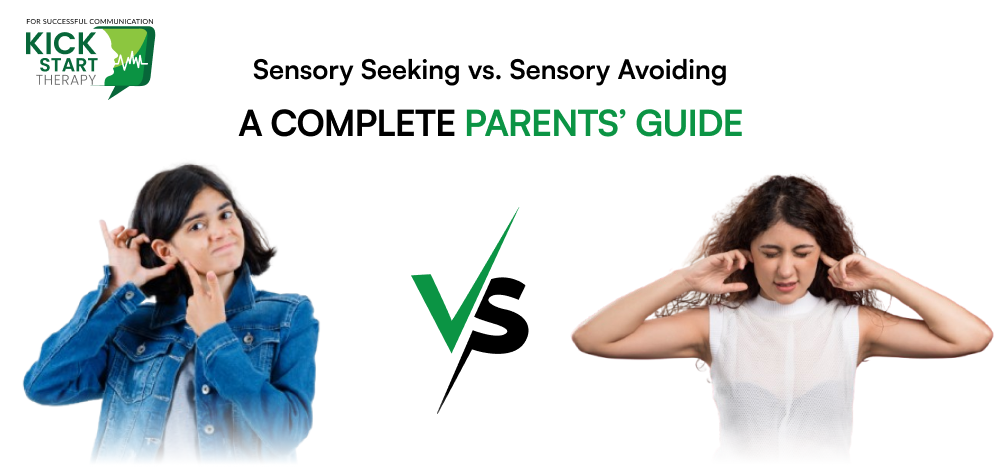
The human brain constantly takes information from the senses and processes it to help us understand and respond to the world around us. While this processing isn’t a problem for many children, some experience challenges in how their brain interprets sensory input. Sensory seeking vs. sensory avoiding are two common patterns seen in children with sensory processing difficulties.
Some kids tend to be sensory seekers who crave extra stimulation and are generally drawn to bright lights, loud music, and cannot resist themselves moving around non-stop or touching objects. In contrast, sensory avoidant children are sensitive to loud music and bright lights, and may shy away from crowded spaces.
Recognizing these sensory behaviours early can help parents and caregivers get the right support for their child and open doors for better recovery, improved coping skills, and overall developmental progress.
Understanding Sensory Processing Disorder in Children
Sensory Processing Disorder occurs when the brain does not regulate sensory information. The signals from the senses reach the brain, but the response is delayed, exaggerated, or muted. Because of this, a child may react strongly to things others barely notice, or may not react enough to things that usually demand attention.
Some children are sensory sensitive, which means even a minor sensory input overwhelms their nervous system and reduces tolerance. Others may show sensory issues in the form of constant movement, seeking pressure, or needing strong input to feel regulated. These responses are the child’s way of trying to balance their system.
Sensory Processing Disorder can appear on its own and is seen in many children without any other diagnosis. However, SPD and autism are often discussed together because they overlap, but they are not the same condition. Sensory processing difficulties are present in the vast majority of autistic individuals, with studies showing that nearly 9 out of 10 experience sensory challenges. These difficulties may appear as sensory seeking behaviors, sensory avoiding responses, or a mix of both.
It is noteworthy that these sensory patterns on their own do not indicate autism. A child can show clear sensory issues and still not meet the criteria for an autism diagnosis. Current prevalence estimates suggest that nearly one in six children experiences sensory processing difficulties independently of autism.
What is Sensory Seeking?
Sensory seeking refers to a pattern where the brain does not register sensory input strongly enough. These children are often under-responsive to sensory information, which means the body needs stronger input to feel alert and aware.
A sensory seeker may appear constantly in motion, loud, or physically intense. Movement, pressure, sound, and touch help the nervous system activate and stay regulated. Without enough input, the child may seem unfocused or disconnected from their body. With adequate input, regulation, and body control often improve, even if the behavior looks excessive from the outside.
Common characteristics seen in sensory seeking children include:
- Standing very close to others due to reduced awareness of personal space
- High tolerance for pain or delayed response to injury
- Heavy footsteps and forceful movements
- Strong need for jumping, crashing, or rough physical play
- Difficulty judging strength, leading to torn paper, broken toys, or accidentally hurting oneself
- Frequent touching of people or objects
- Seeking loud sounds or making noises
- Chewing on clothing or non-food items
Sensory seeking can exist alongside sensory sensitive patterns. A child may actively seek certain input while reacting strongly to others. This combination is common and often misunderstood.
What is Sensory Avoiding?
Not sure if your child needs OT, physio, or both?
Our team includes both pediatric occupational therapists and physiotherapists working together. A short call helps clarify which is the right fit for your child.
Sensory avoiding is a sensory processing pattern where the brain reacts too strongly to sensory input. The nervous system stays on high alert, treating normal levels of input as excessive or threatening. Because of this heightened response, the child’s natural reaction is to limit exposure.
Children who show sensory-avoiding patterns are often sensory sensitive. Their system picks up details quickly and intensely, leaving little room for filtering. When too much information comes in at once, the brain struggles to organize it, which can lead to stress, shutdown, or strong emotional reactions.
Common sensory issues seen in sensory avoiding include:
- Discomfort with close physical contact, including hugs
- Strong startle responses to sudden sounds or bright light
- Awareness of background noises others ignore
- Distress when bumped or touched unexpectedly
- Refusal to wear certain fabrics or fitted clothing
- Avoidance of swings, climbing, or fast movement
- Difficulty judging body position in space
- Preference for quiet settings and limited social exposure
How Common are Sensory Differences in Kids?
Sensory differences are far more common in children than many families realize. A report by CDI Spaces noted that sensory issues affect a noticeable portion of school-aged children, with estimates ranging between 5-16% percent.
As mentioned above, sensory issues are also very common in autism. Current monitoring data show that about 1 in 31 children identified with autism have sensory processing differences. Many autistic children display strong sensory seeking or strong sensory avoiding patterns.
Importantly, sensory issues are not limited to autism. Research in general education classrooms has found that 13.7% of kindergarteners meet criteria for sensory processing difficulties based on parent observations alone.
Sensory Seeking vs. Sensory Avoiding: Key Differences at a Glance
| Area of Difference | Sensory Seeking | Sensory Avoiding |
| Nervous system response | Sensory input is registered as too little, so the nervous system pushes for stronger signals to feel alert and organized | Sensory input is registered as too much, keeping the nervous system in a constant state of overload |
| Movement patterns | Constant motion, crashing, jumping, heavy steps | Limited movement, caution with speed, avoidance of unstable surfaces |
| Touch response | Frequent touching, pressure seeking, and rough handling of objects | Discomfort with unexpected touch, strong preference for control |
| Sound response | Seeks loud sounds or makes noise to stay regulated | Distressed by background noise or sudden sounds |
| Pain response | Delayed or reduced reaction to pain | Strong or immediate reaction to minor discomfort |
| Emotional regulation | Dysregulation when under-stimulated | Dysregulation when over-stimulated |
| Common misinterpretation | Seen as impulsive, careless, or aggressive | Seen as anxious, rigid, or withdrawn |
Can a Child Be Both Sensory Seeking and Sensory Avoiding?
Yes, a child can show both sensory seeking and sensory avoiding patterns at the same time. This is actually common and reflects how different sensory systems within the brain operate independently.
A child may actively seek strong movement or pressure because those signals are not registered clearly enough. At the same time, the same child may be sensory sensitive to sound, light, or touch, where even small amounts of input feel overwhelming. These mixed responses show uneven sensory regulation rather than a single sensory profile.
Children with mixed sensory patterns are often misunderstood because their responses change depending on the type of input involved. Seeking behaviors may be misread as impulsive, while avoiding behaviors may be mistaken for anxiety or rigidity.That’s the biggest similarity between Sensory Seeking vs. Sensory Avoiding.
When to Seek Professional Help?
Professional support becomes important when sensory issues start interfering with a child’s daily functioning. Occasional preferences or dislikes are common, but consistent difficulty managing sensory input is a sign that the nervous system needs guidance. If sensory responses begin to affect learning, social interaction, emotional regulation, sleep, or participation in routine activities, evaluation should not be delayed.
Occupational therapy has proven to be helpful in supporting sensory processing challenges. A trained occupational therapist assesses how the child’s nervous system responds to different types of input and identifies where regulation breaks down. And also differntiates between Sensory Seeking vs. Sensory Avoiding conditions. Therapy focuses on improving sensory integration, body awareness, and self-regulation in a structured and supportive way.
Early intervention reduces long-term impact and prevents mislabeling behaviors as emotional or behavioral problems. Kick Start Therapy specializes in sensory-focused Pediatric occupational therapy, offering individualized support plans that align with the child’s needs and developmental level. Seeking help early allows the child to build regulation skills that support learning and everyday functioning.
Conclusion
This guide explains Sensory Seeking vs. Sensory Avoiding as two distinct yet often overlapping sensory processing patterns seen in children. It breaks down how Sensory Processing Disorder affects the brain’s ability to regulate input, leading to either under-responsiveness or heightened sensitivity.
By outlining clear characteristics, prevalence data, and mixed sensory profiles, we have tried to help parents understand behavior through a neurological lens. The guide also highlights when professional support becomes important.
FAQs
What is the Difference Between SPD and SPS?
Sensory Processing Disorder (SPD) is a neurological condition affecting how the brain interprets sensory input, while Sensory Processing Sensitivity (SPS) is a personality trait involving heightened awareness and emotional responsiveness to stimuli.
Is SPD Considered Neurodivergent?
Yes, SPD is considered neurodivergent because it reflects atypical sensory processing in the nervous system, differing from typical development and affecting behavior, learning, and daily functioning.
How to Calm Down a Sensory Seeker?
Provide safe, controlled sensory input like fidget tools, weighted blankets, or movement activities. Structured routines, deep pressure, and predictable environments can help regulate arousal and reduce overstimulation.
Can a Child be Sensory Seeking Without Being Autistic?
Sensory seeking behaviors can occur in children with SPD, ADHD, or typical development, without any autism diagnosis, reflecting individual differences in sensory thresholds and regulation.
What are Examples of Sensory Seeking in Adults?
Adults may seek intense experiences like spicy foods, loud music, extreme sports, tactile stimulation, or fidgeting, often to satisfy high sensory thresholds or to self-regulate emotions and focus.
Concerned about your child’s development? Schedule an assessment at KickStart Therapy in Brampton or Mississauga.